Mobile Banking Application Modernization
Client / Industry
Banking & Financial Services (Highly Regulated)
Client / Industry
Banking & Financial Services (Highly Regulated)
Problem Statement
A leading Indian bank needed to modernize its legacy on-premise mobile banking platform to support rapidly growing digital adoption, stringent regulatory requirements, and zero-downtime expectations. The existing monolithic architecture resulted in limited scalability, higher operational risk, and inability to deliver seamless customer experiences during peak transaction volumes.
The transformation required a cloud-native, highly resilient, and compliant architecture capable of supporting millions of concurrent users with near-zero downtime.
Architecture Overview
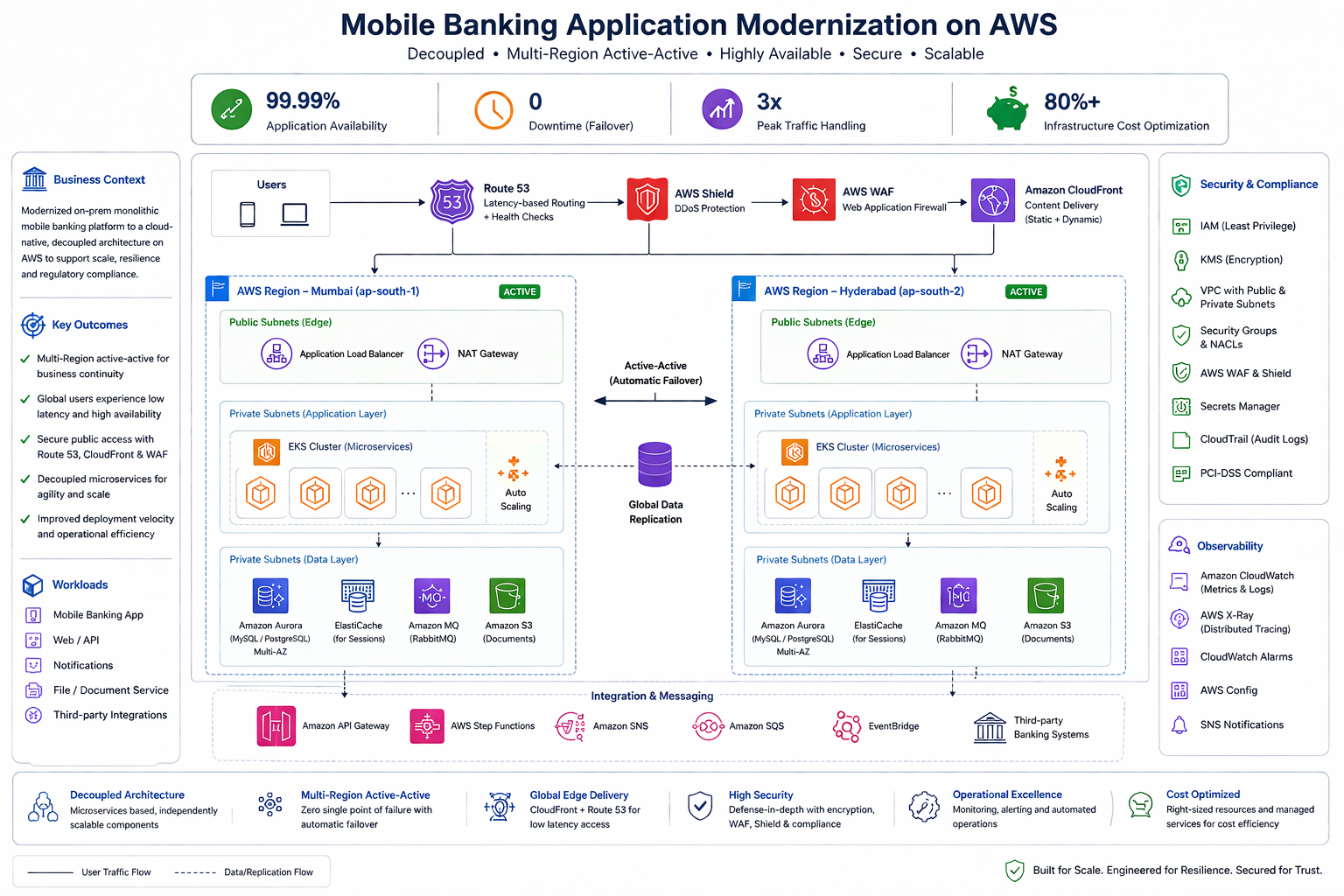
Led the end-to-end modernization as a decoupled, cloud-native architecture on AWS, transitioning from monolithic on-prem systems to microservices-driven distributed architecture.
Designed a multi-region active-active deployment ensuring:
Zero single point of failure
Seamless failover across regions
Low-latency user experience nationwide
Key architecture pillars:
Global traffic routing via Route 53 (latency-based + health checks)
CloudFront + AWS edge network for secure, low-latency content delivery
Decoupled microservices architecture using containerized services (EKS / ECS)
Event-driven communication for scalability and resilience
API-first design with secure external exposure
Implemented enterprise-grade security & compliance controls, including:
Network segmentation (VPC design)
IAM least privilege model
Encryption at rest & in transit
Audit & monitoring aligned with banking regulations
AWS Services
Amazon EKS / ECS, EC2, AWS ALB, Amazon CloudFront, Route 53 (Latency-based routing), AWS WAF, Shield, VPC, IAM, KMS, RDS / Aurora (Multi-AZ), S3, CloudWatch, CloudTrail
Outcomes
Achieved 99.99% application availability with multi-region active-active architecture
Enabled zero-downtime deployments and failover
Reduced infrastructure dependency on on-prem by 80%+
Improved application scalability to handle peak banking traffic (festive spikes)
Enhanced customer experience with lower latency and faster response times
Strengthened security posture and regulatory compliance readiness
Architecture Diagram