Enterprise Data Center Migration for ERP Platform
Client / Industry
Global Pharmaceutical Enterprise (Fortune 500)
Client / Industry
Client: Global Pharmaceutical Enterprise (Fortune 500) Industry: Life Sciences / Healthcare Scale: Multi-region operations with mission-critical SAP ERP workloads
Problem Statement
A global pharmaceutical enterprise needed to exit its on-premise data center under strict timelines while ensuring zero disruption to mission-critical SAP ERP workloads operating across multiple geographies. The challenge was compounded by: Data residency and compliance constraints Tight RTO/RPO expectations for business continuity Legacy dependencies with limited cloud readiness Need for secure, enterprise-grade network connectivity
Architecture Overview
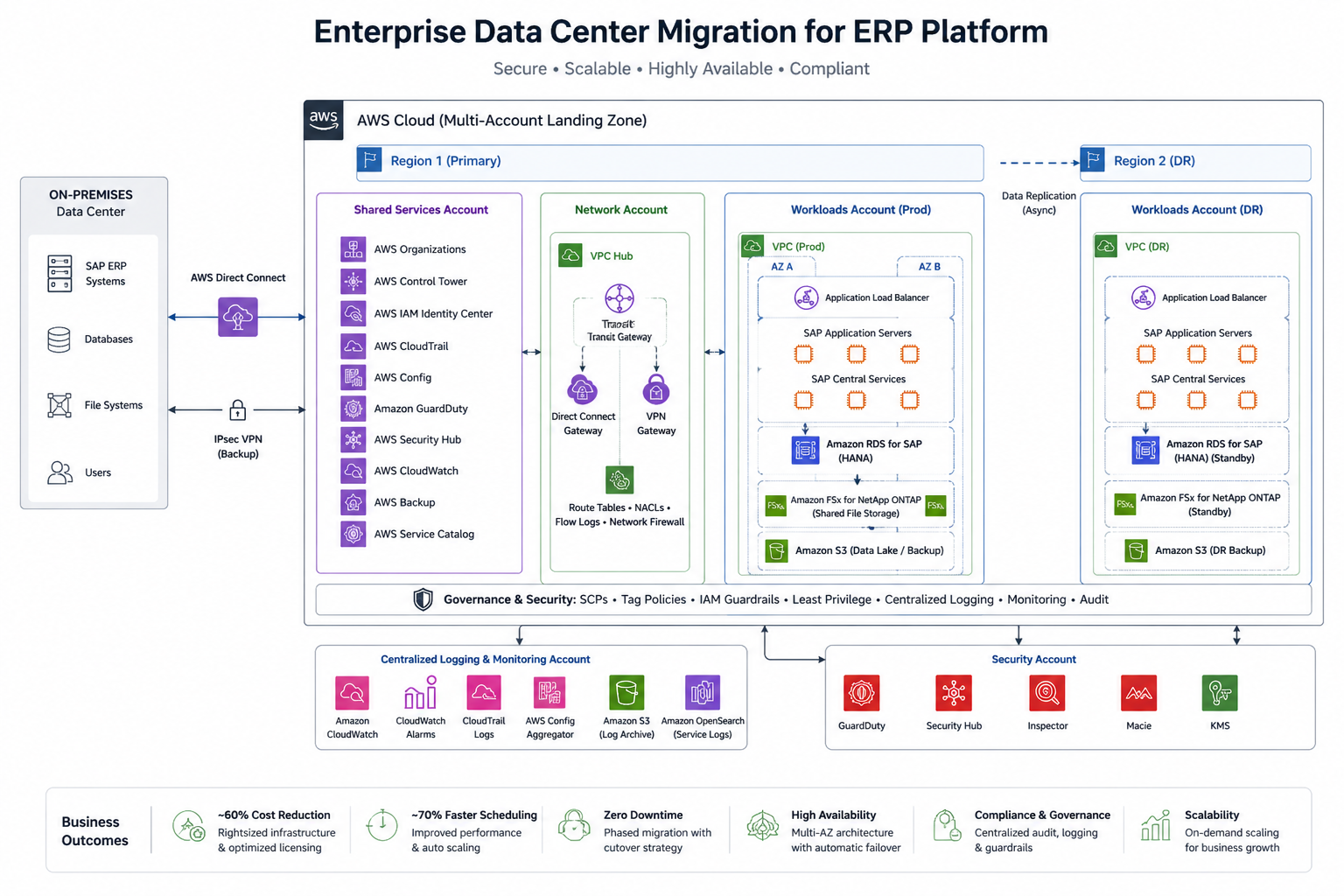
Approach & Architecture Strategy: Led the engagement as Lead Solution Architect, owning the architecture from Landing Zone design through end-to-end migration execution. Designed a phased modernization strategy: Phase 1: Structured lift-and-shift to accelerate data center exit Phase 2: Targeted refactoring to enable high availability and scalability Phase 3: Optimization for cost, resilience, and operational efficiency Built a multi-account AWS Landing Zone aligned with enterprise governance and security standards. Cloud Foundation (Landing Zone): Architected a secure and scalable foundation including: Multi-account structure (Prod / Non-Prod / Shared Services) Service Control Policies (SCPs) for governance and guardrails Centralized logging, monitoring, and audit framework IAM strategy aligned with least-privilege access Network segmentation using VPC design best practices Ensured compliance with data residency requirements across regions. Network & Connectivity: Designed and implemented hybrid connectivity architecture: AWS Direct Connect integration with ISP partners High availability setup with redundancy and failover Secure routing between on-prem and AWS environments Optimized latency for SAP workloads This enabled seamless coexistence during migration phases. Workload Migration & Platform Design: Migrated 200+ virtual machines with zero data loss Designed HA architecture across multi-AZ deployments Leveraged EBS Provisioned IOPS for performance-sensitive workloads Implemented backup and disaster recovery using AWS Backup Ensured minimal downtime and business continuity during cutover. Key Architectural Decisions Adopted phased migration over big-bang to reduce risk Designed governance-first landing zone before workload migration Prioritized Direct Connect over VPN for performance and stability Balanced cost vs availability using workload-aware provisioning Decoupled infrastructure to enable future modernization\ Trade-offs & Considerations: Cost vs Resilience: HA design increased infra cost but ensured uptime Speed vs Complexity: Phased migration added steps but reduced failure risk Flexibility vs Governance: SCPs enforced control at the cost of agility
AWS Services
Compute & Migration: Amazon EC2, AWS Application Migration Service (MGN) Storage & Performance: Amazon EBS (Provisioned IOPS) for SAP workloads, Amazon S3 for durable storage Networking & Connectivity: Amazon VPC, AWS Direct Connect (with ISP integration), Route Tables, NAT Gateway Security & Governance: AWS Organizations, Service Control Policies (SCPs), IAM, account-level isolation Backup & Disaster Recovery: AWS Backup for centralized backup management Observability & Audit: Amazon CloudWatch (monitoring), AWS CloudTrail (audit logging)
Outcomes
Successfully migrated 200+ enterprise workloads with zero data loss Achieved 99.99% uptime for mission-critical SAP ERP systems Reduced total operating costs to ~17% of on-premise baseline (~83% cost reduction) Improved deployment speed and operational efficiency Established a secure, scalable, and governance-driven cloud foundation Enabled faster future modernization through decoupled architecture
Architecture Diagram